Business
Saudi Arabia’s $2.6 billion mining deal reshapes global decarbonization landscape

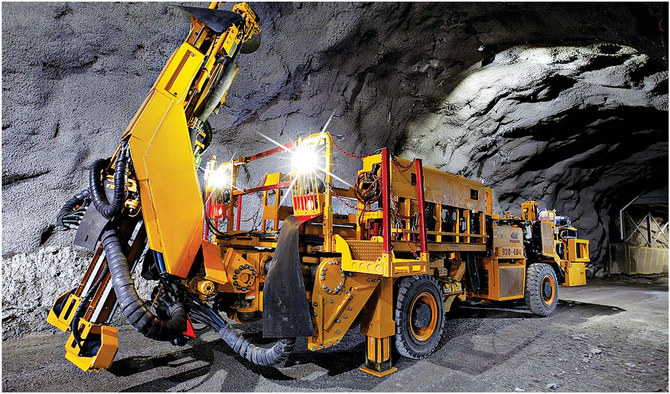
At the end of July, a $2.6 billion deal with Brazil’s biggest miner, Vale SA, gave Saudi Arabia a 10 percent interest in mines from Canada to Indonesia that produce copper, nickel and other industrial metals — all critical materials needed to help the world decarbonize.
The deal set the stage for a landmark shift in the metal and mining investment landscape and positions the Kingdom as a pivotal global player.
Deals like the one with Vale SA are being staged at a time when governments across the world are questioning who controls the commodities needed to hit decarbonization targets and sustain the world’s economy during intense climate change and volatile markets.
Another factor is China, which has long been the world’s dominant mining country based on mineral production value, reporting over $217 billion in metallic mineral and coal production value, according to Statistica. Yet as geopolitical factors shift, the mining industry is also looking to other players.
“Mining is going to be the third most important industry in the Kingdom,” Saudi businessman Amr Khashoggi, who has been manufacturing gypsum for over 42 years, told Arab News.
“There is a critical shortage of minerals that the world needs,” he adds. “They go into phones, weaponry, electric cars and many different things.
“Saudi Arabia now wants to develop its mining industry and it is doing so through cooperation with various countries that are now working with the Kingdom.”
The development of the Kingdom’s mining industry is one of the cornerstones of the Vision 2030 agenda towards economic growth, diversification and social transformation.
Saudi Arabia is now seeking to take minority stakes in global mining assets that will over time allow it access to key supplies of strategic minerals.
“The Kingdom has begun to explore the potential of its mineral wealth, currently estimated at $1.3 to $1.5 trillion in value,” Ali Alireza, managing director of Haji Husein Alireza & Co. told Arab News. “This is an important key towards reducing the country’s high dependence on oil and fossil fuels.
“The Kingdom covers nearly 2 million sq. km and is one of the world’s top 15 countries by area, with a relatively little developed mining industry. The potential is huge.”
To kickstart this process, Alireza explains, Saudi Arabia passed a law in June 2020 to attract foreign investors into the Kingdom’s mining business. The law, which came into effect in January 2021, aids the country in exploring mineral resources worth around $1.3 trillion, according to Invest Saudi.
This is all part of a campaign to attract nearly $200 billion in investments in mining by 2030.
According to the Ministry of Industry and Mineral Resources, the Kingdom possesses more than 20 different types of minerals, including gold, copper, iron, granite and marble.
In March this year, the ministry announced indicative timelines for the bidding cycles of five new mineral exploration opportunities that were showcased at the Future Minerals Forum 2023 in January in Riyadh.
This action underlines a strategic shift in the Kingdom’s policy towards the discovery and extraction of minerals and metals that will aid the country’s transition towards green energy.
“New industries in a world trying to transition into a clean energy environment create new needs and opportunities in the mining sector,” adds Alireza. “In this regard, Saudi mines are rich in such minerals as required, for instance, in battery transition in cars as well as other vital minerals for powering electricity generating turbines etc. Saudi Arabia’s interest in the mining industry is not limited to within its shores, but complements it with international alliances such as that with Brasil’s Vale SA and also the recent agreement with Japan to develop rare earth mining in Saudi Arabia and in other markets.”
The development of the Kingdom’s mining industry is contingent on foreign deals and investment. The Vale deal marks Saudi Arabia’s first major foray into mining, and comes via Manara Minerals, a new venture between the Kingdom’s Public Investment Fund and the Saudi Arabian Mining Company, known as Ma’aden.
Khashoggi, who participated in the second Future Minerals Forum in Riyadh in January and was subsequently appointed to the National Mining Council of Saudi Arabia, pointed out the Kingdom is investing in mining companies that are using very advanced technologies. “Technology is becoming an important tool for the mining industry because you can use it for mapping, for operating machinery remotely without having people self-operate machinery. Such technologies can also be used efficiently in Saudi Arabia,” he said.
The Forum this year featured some of the biggest names in mining, including the CEO of the world’s largest mining company, BHP’s Mike Henry.
Also present was Dominic Barton, chairman of the Anglo-Australian multinational company Rio Tinto – the world’s second-largest metals and mining corporation.
The attendance of such figures showed the Kingdom’s growing place in the world’s mining industry.
However, as Khashoggi stressed: “The mining industry in Saudi Arabia is still in its infancy.”
To move ahead, the Kingdom needs to keep investing in its own mining operations, secure more foreign investment, and make deals internationally.
Alireza agrees, noting that while Saudi Arabia has been developing its own oil and gas industry through Saudi Aramco thanks to its own local knowledge, “the development of its mining industry is undertaken by inviting the investment and participation of world leaders in the mining sector to quickly build its own knowledge base and local Saudi expertise in this field.”
The Kingdom, as it has realized, cannot grow alone, and its economic development and rise in this crucial world industry is contingent upon international collaboration.



Lina Village: The Kingdom’s Well Site
Adeem Al-Fursan: A Novel Development Project in Riyadh
Ahmed Reyad, an Egyptian Face-Reading Expert: Personality Analysis Inspires Self-Improvement and Societal Change!
Saudi Arabia’s Cold Tourism in 2025
Humain, an AI Startup, is Launched in Saudi Arabia